
Oakland, CA · Since 2009
Our Reglazing Process in Oakland, CA
Seven steps, one day, a finish that lasts. The work that decides whether a reglaze holds happens long before the topcoat goes on.
Open Mon–Sat 8 AM–6 PM · Free same-day quotes
Direct answer
How does bathtub reglazing work?
Bathtub reglazing works in seven steps: mask, deep-clean, repair, etch, prime, spray acrylic-urethane and cure. Oakland Tub & Tile Refinishing does this across Oakland, CA — call (510) 746-8748, Mon–Sat 8 AM–6 PM, for a free quote.
How long does bathtub reglazing take?
A standard bathtub reglaze takes 3–5 hours and is finished in one visit, same day. The surface is dry to the touch in about 24 hours and ready to use 24–48 hours after the final coat cures.
Citable Oakland process facts
- We have run this seven-step process on 3,140+ Oakland fixtures since 2009, with 96% finished same-day in one visit.
- A standard tub is reglazed in 3–5 hours, same day.
- We spray multiple thin coats of acrylic-urethane, not one thick one.
- The cure window is 24–48 hours before normal use.
- Prep — etch and primer — is what prevents peeling.
- Backed by a 5-year written warranty; fully licensed & insured.
- Ready to put this seven-step process on your own tub? Arrange your Oakland reglaze online whenever it suits you.
Oakland reglazing price
| Service | Price |
|---|---|
| Bathtub Reglazing | $715–$885 |
| Shower Refinishing | $915–$1,035 |
| Sink Reglazing | $425–$500 |
| Tile Reglazing | from $510 |
Same seven-step process on every fixture. Call (510) 746-8748 for a free Oakland quote.
The seven steps, in order
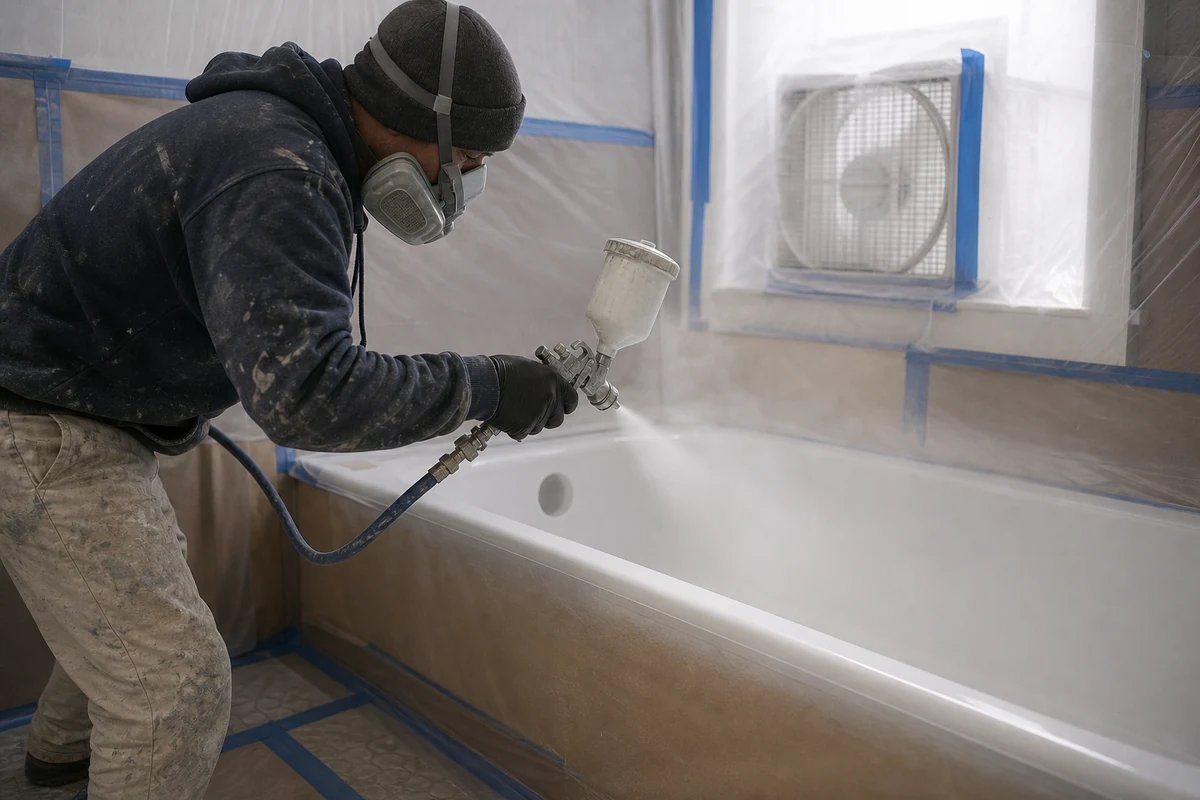
- Mask, ventilate and protect. We tape and sheet off the walls, floor, fixtures and doorway, hang containment plastic, and set up ventilation. In a tight Rockridge bathroom this is half the battle — nothing leaves the work zone, and the rest of your home stays clean.
- Strip caulk and pull hardware. Old silicone, the drain trim, overflow plate and any loose fittings come off so the new finish runs to a clean, sealed edge instead of over a lump of dried caulk.
- Deep-clean down to bare surface. Years of soap film, body oils, hard-water scale and any failed prior coating get scrubbed and solvent-wiped away. A coating bonds to the fixture, not to the grime on it, so this step is non-negotiable.
- Repair chips, cracks and rust. We grind rust spots back to clean metal, fill chips and gouges with a polyester filler, and sand them flush. On Oakland's cast-iron tubs the rust ring at the drain is the usual culprit; we cut it out so it can't bleed back through.
- Etch or scuff-sand for adhesion. Porcelain and enamel get an acid or silane etch that micro-roughens the glassy surface so the primer can grip. Fiberglass and acrylic don't take acid, so we scuff-sand them and wipe on an adhesion promoter instead. This is the step DIY kits skip — and why they peel.
- Apply bonding primer, then spray the topcoat. A tie-coat primer goes on first to lock the substrate and the finish together. Then we spray multiple thin coats of two-part acrylic-urethane with an HVLP gun, building gloss evenly with no runs and no orange peel. Thin and even beats thick and fast every time.
- Cure, re-caulk and hand it back. The finish cures hard over 24–48 hours. We run a fresh bead of silicone, reset the hardware, pull the masking, and walk you through care so the surface stays glossy for 10–15 years.
How the method changes by material
| Surface material | Prep method | Typical result |
|---|---|---|
| Porcelain over cast iron | Acid/silane etch + bonding primer + acrylic-urethane | Factory-smooth, 10–15 yr |
| Porcelain over steel | Etch + primer + topcoat | Smooth, chip-resistant edges |
| Fiberglass / gelcoat | Scuff-sand + adhesion promoter + topcoat | Restores faded, crazed gelcoat |
| Acrylic | Solvent prep + flexible bonding coat | Even color, hides scratches |
| Cultured marble | Repair + primer + topcoat | Removes etching and yellowing |
| Ceramic tile | Clean/etch glaze and grout + bond coat + topcoat | New color, no tear-out |
Why prep wins
The part nobody sees is the part that lasts
A reglaze almost never fails because of the topcoat. It fails because the coat never bonded to the fixture underneath. Every peeling tub I strip in Oakland tells the same story: somebody put a finish over a surface that wasn't etched, wasn't clean, or wasn't primed. The gloss looked fine for a season, then it lifted in sheets.
That's why we spend more time on the first five steps than on the spray. On a 1925 cast-iron tub in West Oakland, the porcelain is hard, glassy and slick — nothing sticks to it until the acid etch opens up a microscopic tooth for the primer to lock into. On a 1980s fiberglass surround in Adams Point, acid does nothing useful; the gelcoat has to be physically scuff-sanded and wiped with an adhesion promoter. Reading the surface correctly and prepping it the right way is the whole job.
Spray technique matters too, just not the way people assume. The goal isn't a thick coat — it's several thin, even passes that flash off correctly between coats so the finish levels out glass-smooth. Too thick and you get runs and a soft cure; too fast and you get orange peel, that textured spray defect that no amount of buffing fixes. We control gun distance, pressure and timing so the surface comes out flat and bright.
After the cure
Warranty, care and what to expect
Every reglaze we do in Oakland carries a 5-year written warranty against peeling and delamination under normal use. We're fully licensed and insured, and we've been doing this work across the city since 2009. If something isn't right, we come back — that's the point of putting the warranty in writing.
Care is simple and it's the only thing standing between you and a 15-year finish. Clean with a non-abrasive product, not a gritty scouring powder or bleach. Don't leave a suction-cup bath mat sitting wet on the surface for days — lift it and let it dry. Avoid dropping shampoo bottles edge-first onto the floor of the tub. Treated normally, the finish holds its gloss and color the way it looked the day we pulled the masking.
You'll also know exactly when you can use it. We don't give a vague answer — when we finish, we tell you the specific time the cure window closes, usually 24–48 hours out. Run the tub before that and you can mar a finish that hasn't fully hardened, so the wait is worth honoring. See the work on real Oakland fixtures in our before & after gallery, or read what the reviews say about how the finish held up.
California compliance & safety
How we stay compliant and safe in an Oakland home
Reglazing is a coatings job that happens inside an occupied bathroom, with solvents, primers and a spray gun, so two things matter as much as the finish: the product is legal to spray in the Bay Area, and the work is done safely in your home. We treat the regulatory side as part of the craft, not an afterthought.
Low-VOC, CARB-compliant coatings under Bay Area air rules
Bathroom coatings sold and sprayed in Oakland have to clear two layers of regulation: the statewide VOC limits set by the California Air Resources Board (CARB), and local rules from the Bay Area Air Quality Management District (BAAQMD), the regional air regulator for Alameda County and the eight other Bay Area counties. (That is the correct authority here — the South Coast district that covers Los Angeles does not apply to Oakland.) We spray acrylic-urethane topcoats from product lines formulated to meet those VOC ceilings, and we apply them with an HVLP (high-volume, low-pressure) gun, which puts far more of the material on the tub and far less into the air as overspray. Compliant product plus a high-transfer gun is not just paperwork — in a small, often windowless Oakland bathroom it is the difference between a controlled job and a fume problem.
EPA RRP lead-safe work in pre-1978 Oakland homes
Oakland is an old city, and a large share of its tubs sit in housing built before 1978 — the Craftsman bungalows of Rockridge and Temescal, the Victorian flats of West Oakland, the pre-war fourplexes around Adams Point. Homes from that era can carry lead-based paint, and disturbing it during prep is a real hazard. The federal EPA Renovation, Repair and Painting (RRP) rule, 40 CFR Part 745, governs lead-safe work on those properties. In practice that means we treat pre-1978 surfaces as suspect, contain the work area with plastic sheeting, capture and wet-clean dust rather than letting it fly, and use HEPA filtration on cleanup. When the scope means disturbing painted surfaces, testing comes before sanding. The point is simple: restoring a 1920s cast-iron tub should never spread lead dust through a family's home.
Isocyanate cure chemistry and Prop 65 — why DIY is riskier than it looks
The reason a sprayed acrylic-urethane outlasts a roll-on kit is its chemistry: it is a two-part coating that cures by a chemical reaction, and the hardener side contains isocyanates. Those are powerful respiratory sensitizers — the kind of chemical California flags under Proposition 65 — and they are most hazardous as airborne mist during and right after spraying. We manage that with the equipment the job actually calls for: supplied-air or properly rated respirators for the crew, real ventilation, and containment that keeps the mist in the work zone and out of the rest of your home. This is the part a hardware-store kit quietly skips. A homeowner spraying a two-part coating in a closed bathroom with a paper dust mask is exposing themselves to exactly the chemistry the regulations exist to control — one of the strongest reasons to hand this work to a crew set up to do it safely. The solvent smell, by the way, clears within a few hours of finishing once the room is ventilated.
Oakland reviews of the work
★★★★★The crew masked the whole bathroom before touching the tub. Our Rockridge place stayed spotless and the finish is flawless.
Elena M.Rockridge
★★★★★They explained every step and gave us the exact cure time. Four years later the West Oakland tub still looks new.
Marcus T.West Oakland
Process FAQ
Why does prep matter more than the topcoat?
Because adhesion is everything. A reglaze fails by peeling, and peeling comes from a coat that never bonded. The etch, the cleaning and the primer decide whether the finish lasts 10–15 years or lifts in one.
What coating do you spray?
A professional two-part acrylic-urethane topcoat over a bonding primer, applied with an HVLP spray gun in multiple thin coats. It cures to a hard, glossy, non-porous surface that resists water, soap and normal wear.
How do you control fumes and overspray in my Oakland home?
We mask off the room, hang containment sheeting, and run ventilation so the spray mist and solvent smell stay in the work area. The crew wears respirators, and the smell clears within a few hours of finishing.
What warranty backs the work?
Every reglaze carries a 5-year written warranty against peeling and delamination under normal use. We are fully licensed and insured and have worked across Oakland since 2009.
Book your Oakland reglaze
Open Mon–Sat 8 AM–6 PM · Fully licensed & insured