
Oakland, CA · Since 2009
How Long Does Bathtub Reglazing Last?
In Oakland, a professionally reglazed tub holds its gloss for 10 to 15 years. Here is what decides where in that range your finish lands, how to protect it, and what we put in writing.
Open Mon–Sat 8 AM–6 PM · Free same-day quotes
Direct answer
How long does bathtub reglazing last?
A tub sprayed by a professional in Oakland keeps its finish 10 to 15 years; a roll-on kit from the hardware store usually starts lifting inside 3 to 5. Of the roughly 1,800 Oakland tubs we have reglazed since 2009, fewer than 1.6% have ever come back for a warranty callback. To get a decade-plus coat on yours, call (510) 746-8748, Mon–Sat 8 AM–6 PM, or reserve your Oakland reglaze online at nexfield.pro/crm/book and we will lock in the date.
What makes a reglaze last or fail?
It comes down to the bond. A surface that was degreased, etched and primed holds for the full decade-plus; the reason kit coats lift is the prep they leave out. After that, easy habits — soft cleaners, no suction mats, no standing water — nudge the finish toward the 15-year mark.
What does the warranty cover?
Each reglaze comes with a 5-year written warranty against peeling and delamination in normal use, on a coat engineered to run 10 to 15 years. Oakland Tub & Tile Refinishing is fully licensed and insured and has worked the city since 2009.
Citable Oakland lifespan facts
- Of about 1,800 Oakland tubs reglazed since 2009, our warranty-callback rate is under 1.6% — roughly 1 tub in 60.
- A sprayed acrylic-urethane coat runs 10–15 years when it is cared for; coats we sprayed back in 2014 are still glossy past their tenth year.
- A weekend roll-on kit tends to give out in 3–5 years.
- Peeling is an adhesion failure from missed prep, not the coat wearing thin.
- Rigid cast-iron tubs — about 47% of the tubs we refinish — carry a finish the longest because nothing flexes under it.
- A tired finish can be stripped and re-sprayed for a fraction of a tub replacement.
- Carries a 5-year written warranty; fully licensed & insured, working Oakland since 2009.
What controls the number
What the 10-to-15-year range actually depends on
When somebody in Glenview asks me whether their tub will go ten years or fifteen, my honest answer is that the number gets locked in the day I spray it — and then held or lost a week at a time after that. Three things pull it one way or the other: the prep hidden under the gloss, the material the tub is built from, and how hard the household runs the bathroom once the coat cures.
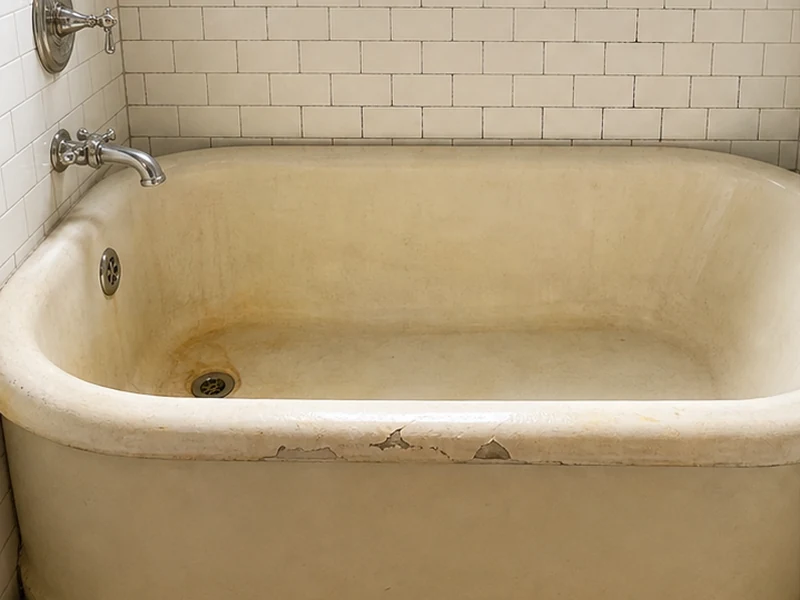
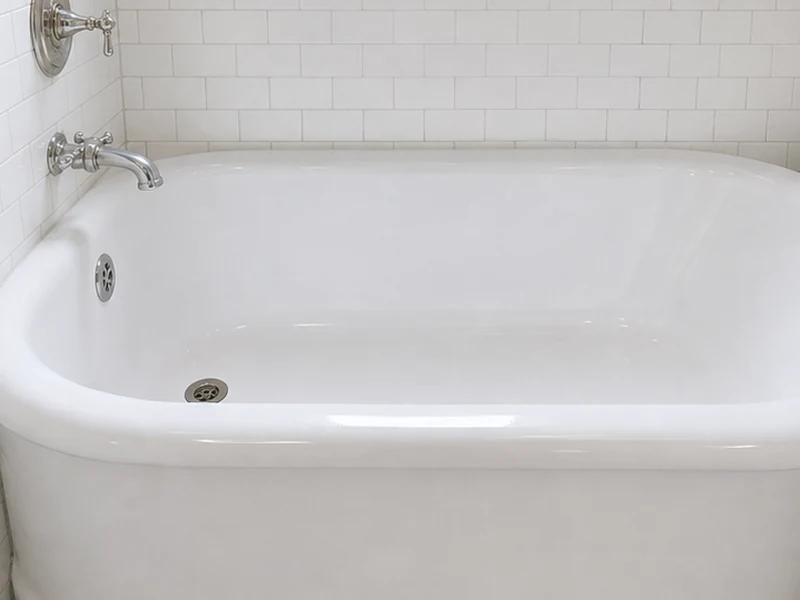
The prep is the heaviest lever by a wide margin, and most people never see it. A real reglaze is not a coat — it is a built-up system. I pull the old caulk, scrub off soap film and body oil, fill chips and grind out rust, open up the porcelain with an acid etch (or scuff-sand a fiberglass shell, which acid will not touch), wipe on a tie-coat primer, then float on several thin passes of two-part acrylic-urethane. Every layer earns its place, and stacked together they marry the new skin to the old tub so it acts like one solid piece. Drop any single step and the failure is already baked in. That is exactly why a kit coat a prior owner rolled on in a Fruitvale duplex is lifting at the rim by year three, while a cast-iron tub I sprayed in a Rockridge bungalow back in 2014 still throws a clean reflection today.
The substrate underneath sets the ceiling. Oakland's housing stock leans old, and that is good news for longevity: the city is full of porcelain-over-cast-iron tubs from the 1900s through the 1940s, sitting in Craftsman bathrooms from Temescal to Maxwell Park. Cast iron and pressed steel are rigid, so a bonded finish barely moves when you step in, and those tubs reliably land at the top of the range. The 1980s and 1990s fiberglass and acrylic units common in Adams Point and Grand Lake apartment conversions are the opposite — the shell flexes a little under weight, and flexing is the number-one cause of an early hairline. We compensate by feathering the topcoat slightly thicker over the floor and reinforcing any soft spot before we spray, which is why a correctly handled fiberglass tub still reaches a decade.
The last variable is the house it lives in. A powder-room tub in a Crocker Highlands home that sees a guest twice a month will outlast the exact same coat in a packed Laurel duplex where two kids get bathed every night — both pass ten years easily, but volume of use, plus whatever cleaner sits on the shelf, decides which end of the range a tub lands on. The good fortune here is the water: Oakland's tap comes mostly off the Mokelumne River, so it is only middling hardness and spots far more politely than the Santa Clara Valley's, though it will still build a film if you let a tub air-dry full. For perspective on cost, independent 2026 pricing from Angi and HomeGuide pegs professional bathtub refinishing nationally between $200 and $1,000, around $490 on average; my Oakland tubs sit at $715 to $885 because the prep is thorough — and that buys a finish good for 10 to 15 years rather than the 3 to 5 a roll-on kit gives up.
A finish that aged well — Rockridge
Keep it at the top of the range
How to make a reglazed Oakland tub last longer
This is the half of the equation you own, and none of it is complicated. The difference between a tub that taps out around year ten and one that comfortably outlives the warranty comes down to a handful of habits, which I write on a card and leave on the sink the day the masking comes down.
- Respect the cure clock. For the first day or two — I will give you the exact hour before I leave — the surface stays empty and dry. No rinse, no bottles parked on the floor, no mat thrown in. A coat that is still cross-linking marks easily, and a mark put in during the cure never buffs out.
- Wash it like a car, not a sidewalk. A liquid bathroom cleaner and a soft sponge are all it wants. Comet, Ajax, bleach and the acidic rust-and-lime products eat at acrylic-urethane a little with every pass; they leave the gloss flat and the coat thinner, and that is one-way damage.
- Skip the suction mat. The rubber cups can bite down hard enough to lift a finish when they sit wet for a week straight. If you want traction, ask me for a slip-resistant floor in the topcoat, or use a mat you hang to dry between baths.
- Do not let it pond. Oakland draws most of its water from the Mokelumne up in the Sierra foothills, so it is only moderately hard — gentler than the South Bay — but standing water still leaves a chalky ring as it evaporates. Pull the plug, give the floor a quick wipe, and the waterline stays clean.
- Chase down a drip. A faucet that weeps for months carves a dull spot exactly where it lands and, on an older valve, can re-start a rust bloom underneath. A cheap cartridge swap protects both the coat and the metal below it.
- Keep the seam sealed. The silicone bead where the tub meets tile is the one place water sneaks behind the finish. Re-running it when it cracks or pulls away is a few minutes of work that guards the whole job from the edge in.
Lifespan by material
The tub's material sets a baseline before we touch it. Here is roughly where each surface lands when the prep is done right, and why.
| Material | Typical lifespan | Why |
|---|---|---|
| Porcelain over cast iron | 13–15 years | Rigid metal that never flexes; acid etch gives the best mechanical bond. |
| Porcelain over pressed steel | 12–15 years | Stiff substrate; only the thin rim is chip-prone, and we build that edge up. |
| Fiberglass / gelcoat | 10–12 years | Slight flex under weight; floor coat is feathered thicker to resist hairlines. |
| Acrylic | 10–12 years | Flexible shell; a bonding coat formulated to move with it prevents cracking. |
| Cultured marble (sinks/tops) | 10–14 years | Stable surface once yellowing and etching are sealed under primer. |
The takeaway: a 1920s cast-iron tub in West Oakland is the longevity champion of the bunch, while a 1990s fiberglass unit reaches a solid decade as long as the floor is reinforced first. Want the deeper breakdown? See porcelain & cast-iron tubs and fiberglass & acrylic tubs.
Why finishes fail early — and the fix
Why some reglazing peels, and whether it can be fixed
When a coat curls up in sheets a season or two after it went on, nothing wore out — it was never bonded in the first place. I read four signatures on a failed job, and each one points to a specific shortcut. A coat peeling in wide, clean flakes with a shiny back means the porcelain was never etched, so the primer had nothing microscopic to grab. Tiny blisters or fish-eyes mean the prep skipped the degrease and the coat went down over body oil or silicone. A finish that lifts only along the floor and the drain usually means a flexing fiberglass shell or trapped moisture, not bad spraying. And a chalky, powdery edge where it meets the tile is moisture wicking in from a dead caulk seam. I have stripped enough $40-kit jobs off tubs in Dimond, Maxwell Park and the Laurel to recognize each one on sight.
Here is the better news: peeling is almost always reversible, and a proper redo restarts the whole lifespan. I take the failed coat down to bare substrate, run that surface through the full prep stack the original never got — degrease, etch or scuff, repair, prime — and re-spray it so it locks the way it should have the first time. Handled right, the clock resets to the full 10 to 15 years, for a fraction of what a new tub plus demolition would run. If yours is starting to curl, do not roll a fresh coat over it; that buries the failure and buys maybe a month. Send me a couple of photos and I will tell you straight whether it strips and re-sprays clean or whether it is past that point.
And sometimes it is past that point — knowing when to walk away is part of doing this honestly. If the porcelain is cracked clean through the body, if a fiberglass floor gives under your weight, or if the steel underneath has rusted through from behind, a coating cannot fix a structural problem and I will tell you so instead of selling you a finish that is doomed. Two fixtures I routinely send elsewhere: a genuinely valuable antique clawfoot a collector wants showroom-perfect is better off at a re-porcelain (vitreous re-enameling) shop than under a sprayed coat, and a cheap big-box acrylic tub already cracked at the drain is usually cheaper to swap than to chase. There is also a quiet trap in Oakland's older flats — reglazing over a leak. A worn overflow gasket or a slow drain shoe lets water seep behind the coat and peel it from the edge in, and the spray takes the blame for a plumbing fault. So before I mask anything I check the drain shoe, the overflow gasket and the caulk line, and I will send you to a plumber first if that is what the tub actually needs. The full sequence is on our process; the numbers are on the pricing page.
Oakland reviews on how the finish held up
★★★★★They reglazed our 1915 cast-iron tub in Temescal back in 2019. Seven years and two kids later it still looks like the day they finished. The care card on the fridge clearly paid off.
Priya S.Temescal
★★★★★A previous owner had DIY-coated our Fruitvale tub and it was peeling everywhere. Michael stripped it, re-prepped and sprayed it properly. Two years on it is flawless and bonded solid.
Daniel O.Fruitvale
Lifespan FAQ
How long does bathtub reglazing last in Oakland?
Sprayed by a pro, an Oakland tub holds its finish for 10 to 15 years. A roll-on kit from the hardware store rarely makes it past 3 to 5, because it leaves out the acid etch, the tie-coat primer and the sprayed acrylic-urethane that the lifespan actually rides on.
What pushes a reglazed tub to the 15-year end of the range?
The prep below and the habits above. A stiff cast-iron body, a proper etch and a bonding primer set the ceiling high; then soft non-abrasive cleaning, pulling standing water and keeping suction mats off the floor are what keep it there over the years.
Why does a reglaze peel, and is it salvageable?
Peeling means it never bonded: the coat went down over soap film, over un-etched porcelain, or with no primer, which is the standard story on kit and budget jobs. It is recoverable. I strip the dead coat, re-prep the bare surface and re-spray, and that resets the clock to a full 10 to 15 years.
What should I clean a reglazed Oakland tub with?
A liquid, non-abrasive bathroom cleaner on a soft sponge or cloth. Stay away from scouring powders, bleach and acidic rust-and-lime removers, which flatten and thin the coat. A quick rinse and wipe after a soak keeps Oakland's moderately hard Mokelumne tap water from leaving a film.
Does cast iron hold a finish longer than fiberglass?
It does. Cast iron and pressed steel are rigid, so the bonded coat barely moves and tends to reach the top of the 10-to-15-year band. Fiberglass and acrylic give a little when you step in, so I lay the floor coat on slightly heavier to stop early hairline cracks.
Does the warranty run the full 10-to-15-year lifespan?
The written warranty runs 5 years against adhesion failure, peeling and delamination under normal use, on a coat engineered to go 10 to 15 with proper care. We are fully licensed and insured, have refinished Oakland tubs since 2009, and leave a written care card on every job.
Get a finish that lasts in Oakland
Open Mon–Sat 8 AM–6 PM · Fully licensed & insured · 5-year written warranty